
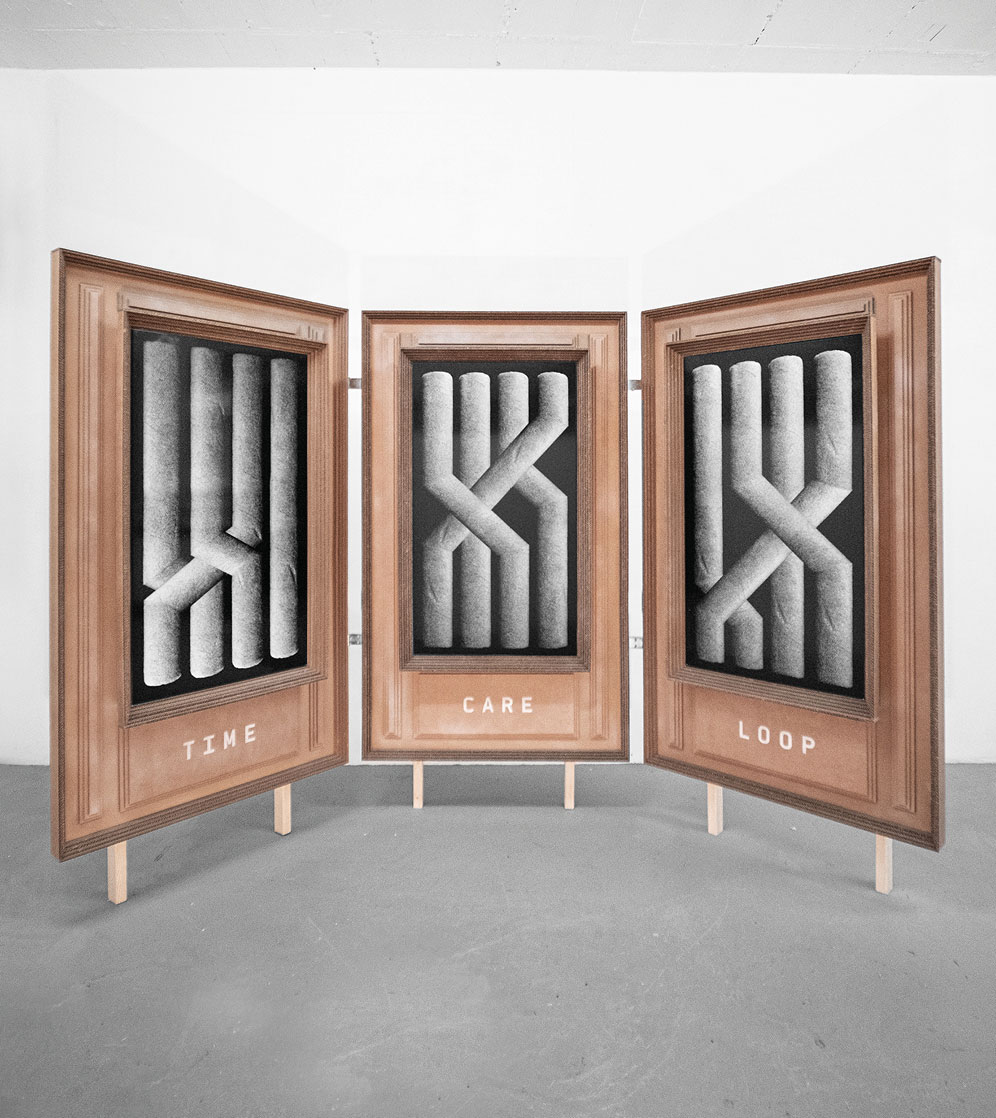
Matthias Gubler: TIME CARE LOOP
Online Viewing RoomNov. 20, 2026 10:00 AM
Thalwil
This video installation by Matthias Gubler explores the perception of time, attention and the little things in everyday life. Three portrait-format screens – set within cardboard panels featuring delicate geometric frames – stand side by side, forming an upright, altar-like structure. Within the small cottage where the installation is on display, this creates a temporary space for reflection – a place dedicated less to religious devotion than to a conscious form of attention. The terms TIME, CARE and LOOP are displayed on the three panels. They function as three open-ended attitudes whilst simultaneously forming a conceptual connection.
TIME
Time is not merely a measurable quantity, but a fundamental experience of life. It describes stages of life, changes and transitions, but also the many small intervals of time that make up our everyday lives.
In fffound, time is viewed as something that is increasingly fragmented in daily life and overshadowed by distraction. Attention is divided, moments are skipped over, and even free time is often filled with stimuli, information and activities. As a result, the immediate experience of a moment and the conscious perception of the ‘now’ can fade into the background.
The installation counters this acceleration with a different form of time. The videos demand nothing and lead nowhere. Rather, they open up a temporal space in which simply lingering becomes the content itself. Here, time does not need to be utilised or optimised. It is simply allowed to unfold.
CARE
CARE denotes a quality of attention and, at the same time, a form of care. The term refers to resilience, self-care and the conscious act of attending to one’s own perception and surroundings.
This attention is not directed towards the extraordinary, but towards the simple. Small objects, materials and movements, which are usually perceived only in passing or completely overlooked in everyday life, are given their own space.
fffound understands this form of observation as a possible practice of care: looking more closely, lingering on something, and experiencing one’s surroundings once again as something perceptible and meaningful. Paying attention to an unremarkable object can also become a form of self-care.
LOOP
The LOOP initially describes an experience of everyday life: recurrence, repetition, the feeling of moving round and round in routines and sequences, always returning to the same point. Work, consumption, communication and everyday obligations can create a rhythm reminiscent of a hamster wheel. Days follow one another, whilst one’s attention is often already focused on what comes next.
At the same time, repetition can take on a different quality. In fffound’s Loops, the constant repetition of the same thing does not become a burden, but rather an opportunity to look anew. Because nothing needs to be decided or concluded, a moment of tranquillity arises within the repetition. With each recurrence, a movement, a material, a surface or a small detail is given the chance to be rediscovered.
The loop thus becomes a counter-model to everyday repetition: not as a cycle from which one must break free, but as an opportunity to linger within a moment.
Here, the loop reconnects with TIME. Repetition keeps a moment open and gives it duration. It makes it possible not only to see something beautiful once, but to perceive it repeatedly. From this lingering arises a different perception of time.
TIME, CARE and LOOP are therefore not separate concepts. They describe three interconnected ways of approaching everyday life differently: consciously perceiving time, understanding attention as a form of care, and finding, through repetition, a space for tranquillity and renewed perception.
The installation invites you to step into this space for a moment – not to find anything in particular, but perhaps to perceive once more what is already there.
The video installation «TIME - CARE - LOOP» explores the perception of time, attention and the little things in everyday life. In his work, Matthias Gubler repeatedly turns his gaze towards the inconspicuous. What normally lies on the fringes of our perception takes on a significance of its own in his works. What is supposedly trivial becomes the actual event.
His fffound series is therefore not about spectacular finds or major discoveries, but perhaps about something far more difficult: rediscovering what is already there, yet which we often overlook in the flow of our everyday perceptions. When I recently visited the washhouse with a friend, she remarked: ‘You have to earn this work by giving it your time.’ Indeed, one is often rewarded with something unexpected as soon as one takes the time (TIME) to observe, to allow an encounter to happen, to care (CARE) and then to realise that meaning does not necessarily arise from the extraordinary. It often lies in the small shifts, in the nuances, in the unspectacular (LOOP).
With fffound, we are invited to take a seat in an altar-like space, to pause, and to surrender to the flow of repetition – and perhaps to rediscover something or see it anew. At the same time, we listen to the sounds and frequencies from the ‘Cosmic Octave’ according to Hans Cousto, compiled by Eduardo Kiefer. The work completely absorbs us – provided we give it the time – enabling us to be fully present for a moment. My girlfriend and I prolonged the moment and at some point realised we were half-frozen – that’s how deeply we were absorbed together in front of fffound.
Introduction by Serap Vitarelli, co-curator at Waschhaus Thalwil, on the occasion of the opening on 5 November 2026