
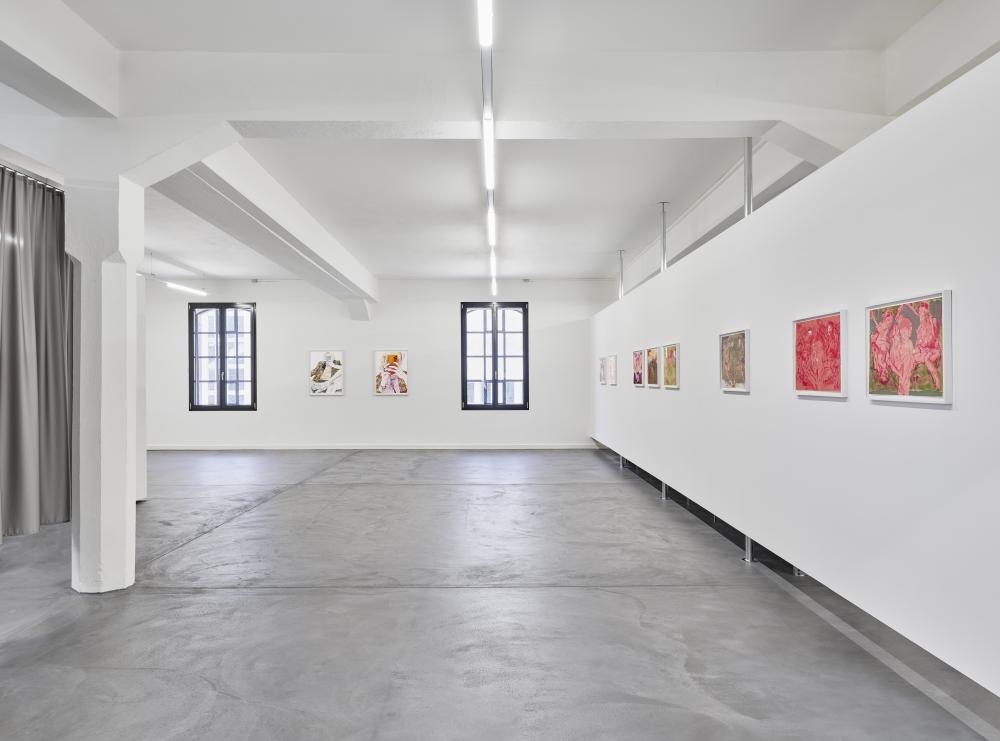
Valentin Rilliet: Storylines
Online Viewing RoomSep 26, 2026 11:00 AM
Jan 16, 2027 10:00 AM
Verena-Conzett-Strasse 7
8004 Zürich
The exhibition “Storylines” brings together new editions by Valentin Rilliet, Yoan Mudry, Romane de Watteville, and Jeanne Jacob, in which individual images become starting points for open-ended narratives. The title can be read in two ways: as a reference to narrative threads that intersect, break off, or are taken up again, and to the drawn and printed line from which the images emerge. These painterly works were realized through lithography, monotype, and screen printing.
The four artists draw on myths, art-historical motifs, film, comics, advertising, social media, and personal observations. Figures appear in mid-motion, gazes meet, bodies touch, and animals and mythical creatures look out at us. What happened before these scenes and what might follow remain beyond the frame. The works offer clues but do not establish a definitive plot. Their stories emerge where the depicted meet the memories, expectations, and imaginations of the viewers.
Valentin Rilliet’s four lithographs were created during a workshop held over nine months at the Wolfensberger lithography studio. The stones used for each work determined its format and framing, while each layer of color required the composition to be recalibrated. Rilliet used this slow process to further develop the varied visual language of his practice. In “Heist,” the moment of harvest becomes a possible crime scene, while “Ghost of a Dragonfly” places a massive red mythical creature opposite an almost weightless dragonfly. In “Aquamarine,” the act of holding a carp-like fish becomes an encounter poised between rescue and struggle. The large-format work “An Escape in Jade” brings together Janus-headed female figures, an elegant interior, and gray clouds in a spatially fragmented scene. Rilliet works much like a filmmaker or writer who returns to characters and situations and gives them new roles. One important source is lianhuanhua, popular Chinese picture stories whose figures and image fragments he places in new contexts. The four sheets thus appear as episodes from a larger mythology glimpsed only in part.
Yoan Mudry’s screenprint “Stan 3” is based on a painting from the series “A brief history of humanity and how it will end.” A cute cat looks back at us with large eyes, while the background resembles a cloud of smoke, as though the world has already crumbled into ash. The contrast between the familiar animal and the possible end of humanity is both humorous and unsettling. Images of cats can offer comfort in times of uncertainty, but may also be read as a distraction or an expression of feeling overwhelmed. Mudry has long worked with found text and imagery from advertising, book covers, comics, films, and the internet. His collage-like compositions are initially created on screen and subsequently translated into painting or printmaking through a time-consuming process. In “Stan 3,” an image that might have emerged from rapid digital circulation returns to physical form. The cat appears as a source of comfort, a site of projection, and the possible last witness to a future without humans.
In her two large-format lithographs “Show Me” and “Mix and Match,” Romane de Watteville makes the act of looking itself the subject of the images. A protagonist points her smartphone toward us. Are we watching her take a selfie, or have we ourselves entered her camera’s field of view? The smartphone is at once a lens, a screen, and a barrier between the depicted figure and the viewers. Through precisely chosen framing and perspectives, de Watteville draws us into the scene without clearly defining our position within it. Through her clothing, shoes, and accessories, the protagonist, who serves as the artist’s alter ego, moves between glamour, kitsch, and costume. The snapshot aesthetic holds the situation in suspension between a self-assured pose and retreat behind the screen. A familiar everyday motif thus gives rise to a narrative about observation and self-presentation, but also about the proximity and distance that digital images simultaneously create.
Jeanne Jacob’s series “Known gestures whatever happens” comprises 15 unique works combining lithography and monotype. Two lithographic motifs form the framework: in the first, one person holds another in their arms; in the second, two people sit opposite each other and their feet touch. The gestures appear familiar but cannot be clearly defined. They may be protective, tender, or possessive and recall Pietàs and angels as much as codified depictions of heroic acts in film. Jacob printed the motifs in different variations and then continued working on each sheet using monotype. Landscapes and clouds enter the compositions; individual elements disappear, while heads, animals, and hybrid creatures emerge. Each sheet thus develops its own narrative. The androgynous bodies and their pronounced vulnerability resist fixed roles and conventional ideals of beauty. Between struggle and tenderness, Jacob explores how intimacy can be represented, performed, and genuinely felt.
The four positions are united less by a shared aesthetic than by a particular form of open-ended storytelling. Animals and mythical creatures, visions of the end of humanity, a camera directed at us, and an ambiguous touch become starting points for possible stories. The crucial moments are left out. As a result, the scenes can take a different direction with every viewing. The printmaking processes further reinforce this openness. In lithography, images emerge from individual layers; monotype transforms a recurring point of departure into unique works; and screen printing returns a circulating image to material form. At a time when images circulate in rapid succession and are expected to be immediately understood, the works in “Storylines” demand a slower form of looking. The story does not reside in the image alone. It emerges between source and viewing—between what becomes visible and what we imagine beyond it.